More apprentices are starting construction training in Queensland – and completing their qualification – as industry pushes for continued reform to grow its workforce.
This National Tradies Day, Master Builders’ analysis of NCVER data shows construction apprentice completions climbed by 11.7% in the year to March 2026 and jumped 10.8% compared to the same quarter last year.
The number of Queenslanders who started an apprenticeship also rose by 9.1% in the 12 months to March and increased 18.7% across the quarter.
As the workforce shortage remains industry’s greatest challenge, Master Builders Deputy CEO Michael Hopkins said the figures were great news.
“Apprentice numbers moving in the right direction are cause for celebration this National Tradies Day,” Mr Hopkins said.
“The figures prove that when the state government backs construction businesses, our industry responds. The recent measures have helped small businesses via subsidies to take on more apprentices, plus incentives for those taking on an apprentice for the first time and employing priority groups including women, skilled migrants, and mature-aged workers.
“While this is all great news, we know we need almost 20,000 additional construction workers every year until 2035 to meet demand. In addition to the pipeline of public infrastructure, schools, hospitals, and Olympic projects, demand for housing is booming – and right now, we don’t have enough people to keep pace.”
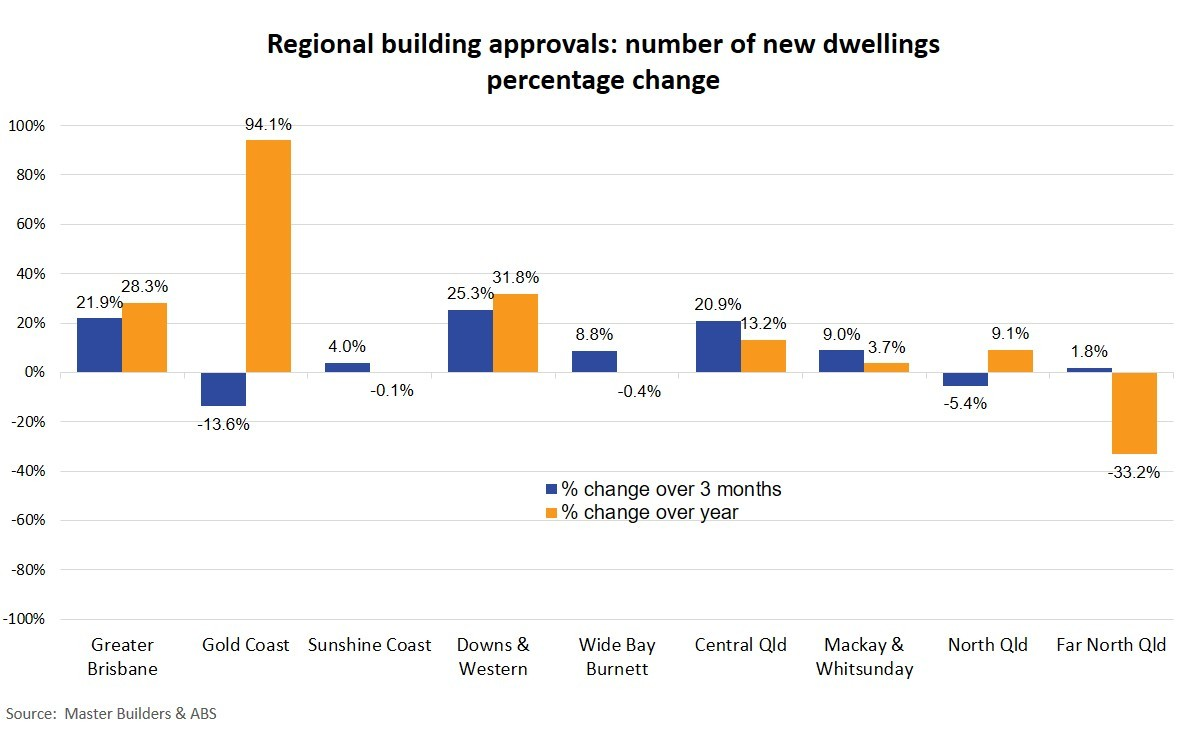
The latest Australian Bureau of Statistics figures show new building approvals jumped 22.7 per cent across Queensland in the year to July. The leading regions were buoyed by new unit approvals, including Gold Coast (+94.1%), Downs & Western (+31.8%), Greater Brisbane (+28.3%) and North Queensland (+9.1%). Central Queensland was the exception, with detached housing driving a 13.2% jump. The Sunshine Coast, Wide Bay and Mackay & Whitsunday remained largely unchanged, while Far North Queensland was the only region to record a significant drop (33.2%) thanks to a fall in approvals for both units and detached houses.
“We need to pull every policy lever available to grow our workforce,” Mr Hopkins said.
“In addition to the existing wage subsidies for businesses, we need financial incentives for apprentices who complete their first year, and attain their trade, to encourage them to stick with us. Schools, careers advisors, parents and carers also have an important role in promoting construction as a career pathway.
“While attracting and training locally will always be our priority, Queensland still needs supplement our local workforce with skilled workers from other Australian states and overseas.
“Just yesterday, we welcomed the federal government’s announcement that skilled migrants in construction will be prioritised in the visa processing queue. But right now, only around 3-5% of the construction workforce comes from skilled migration. We also want to see faster visa processing, simpler skills recognition, a streamlined licensing process to get qualified tradies on the tools faster, and lower costs and administrative burdens for employers.
“The shortage situation is dire. We need workforce attraction, training and migration reforms, yesterday.”